
National Award-winning,
Family-run Newspaper
Family-run Newspaper
On a breezy Thursday afternoon, a crowd gathered at the corner of Route 52 and Loch Sheldrake-Hurleyville Road to witness history in the making.
This is marker number 12 of the Borscht Belt …
This item is available in full to subscribers.
Please log in to continue |
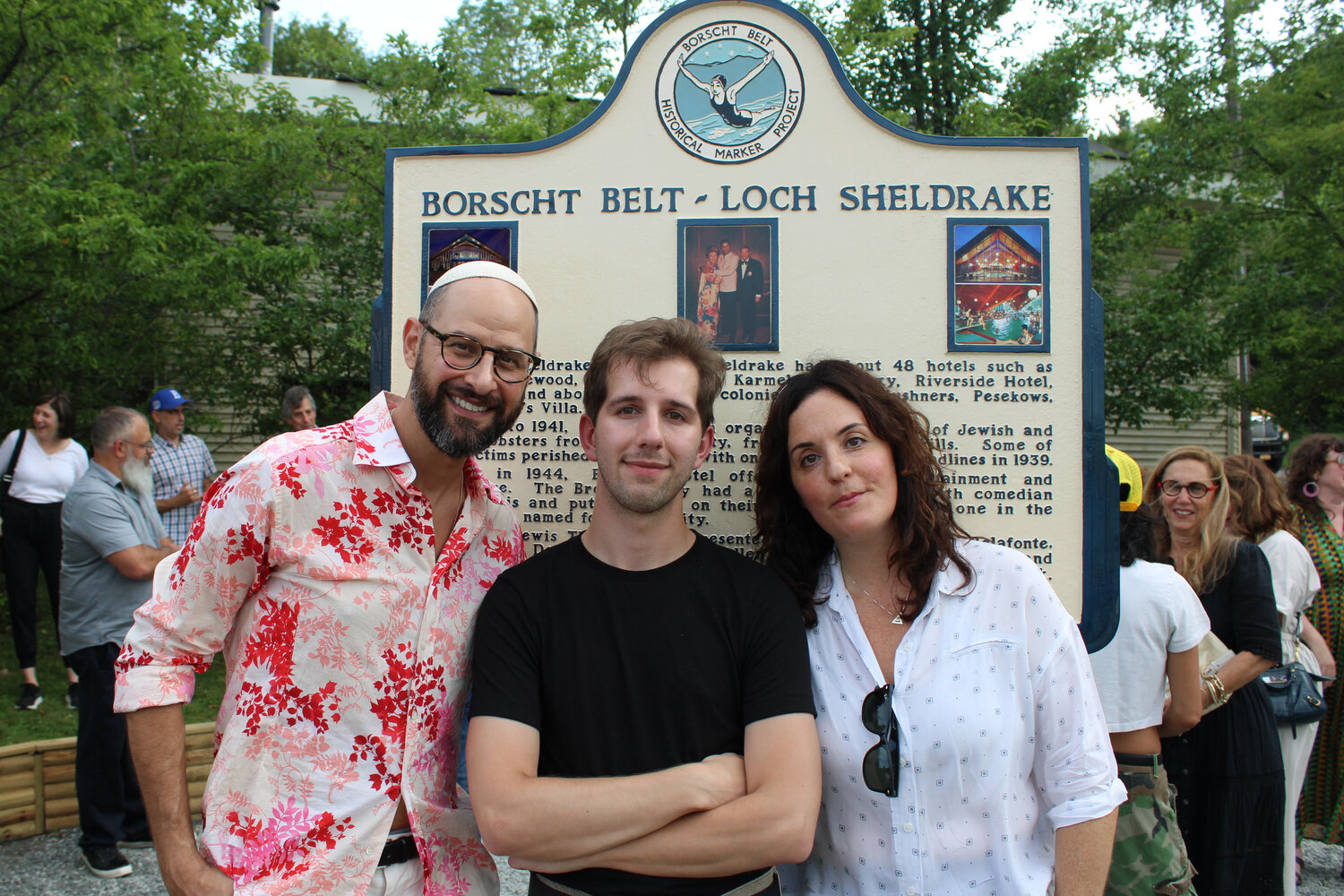


On a breezy Thursday afternoon, a crowd gathered at the corner of Route 52 and Loch Sheldrake-Hurleyville Road to witness history in the making.
This is marker number 12 of the Borscht Belt Historical Marker trail in a series of 20. According to Founder and Project Director Marisa Scheinfeld, each is a “lasting tribute” to ensure the legacy and culture of the Borscht Belt lives on.
“[The entire Marker Project Team] understands that history is not something that is either buried or still, it breathes. It breathes through us and shapes us,” said Scheinfeld. “For generations, Loch Sheldrake was a place where people came searching for joy, connection, and escape.”
She highlighted the area’s many historic landmarks: Brown’s Hotel, Hotel Evans, Green Acres Hotel, Karmel Hotel, Shady Nook, and the Hippodrome Theater.
“These places were more than just destinations, they were landmarks shaping summers, people, and an entire era,” said Scheinfeld. “Yes, much of that world is gone. People say, ‘There’s nothing left.’ Over time I found the answer [how to respond]: you’re just not looking.”
She noted that while Grandview was lost to fire in April 2012, the theater remains, and the site of the former LeRoy Hotel is now Sullivan County Community College.
Project Co-Founder Isaac Jeffreys, who has spent years photographing what remains of these resorts, came to see Loch Sheldrake as more than a place — as a space where “memory lives.”
“There’s a feeling here: something quiet but insistent that speaks to what once was,” he reflected. “A vibrant, deeply rooted culture of summer, family, performance, and escape.”
Jeffreys recalled a moment from the 1986 documentary The Rise and Fall of the Borscht Belt, which showed Sullivan County during the decline of its resorts. He was struck by Seema Nelson, who stood beside the Lakeside Hotel speaking of the heartbreak in selling a property that had been in her family for generations.
He noted the tension between memory and change, and how “change has always been part of the story here.”
“The Borscht Belt legacy continues through those still drawn to these places,” said Jeffreys. “Artists, urban explorers, and locals who feel a deep connection to the atmosphere and history of these old resorts.”
Also speaking was Bruce Turiansky, grandson of Brown’s Hotel founders Charles and Lillian Brown. After college, he worked alongside his grandparents for 22 years.
He shared how the Browns began their hotel business in Lakewood, NJ: a thriving winter resort in the 1930s. They spent winters renting different hotels before buying one in Loch Sheldrake in 1943: the Black Appel Inn, which became Brown’s Hotel.
“For years, I’d find silverware marked B.A.I. Eventually, they disappeared, although I wish I still had some,” Turiansky said.
He described how the hotel, originally about 70 rooms, expanded beginning in 1950 and continued through 1955 and 1958 until it had 560 rooms.
“The one thing I miss most isn’t so much the hotel business, it was living up here,” he said. “I grew to love small-town life. I got to meet people I probably wouldn’t have otherwise.”
Longtime Borscht Belt Chronicle journalist Barry Lewis spoke of how, while many remember the hotels with affection, others — especially staff — had different experiences. He shared his memory of the Shady Nook Strike of 1977, when he and other busboys were put in unheated staff quarters during Passover.
“We stayed one night, slept in our jackets, and showered with animals I didn’t even know existed,” said Lewis. “The second night I was sleeping in the lobby when one of my guests walked over and asked, ‘Barry, is that you?’ Then whispered, ‘Can you get me a cup of Sanka?’”
Hayley Samen, granddaughter of Stagedoor Manor founders Carl and Elsie Samuelson, also spoke. Samen, now Associate Producer, shared the connection between the Karmel Hotel and Stagedoor’s legacy.
“The Karmel Hotel has a legacy we are proud to be connected to,” said Samen. “When it closed, my grandparents saw an opportunity to live out their dream: a camp where every child who loved the stage could find a home.”
After the presentation, attendees with tickets went to the preserved Fan Fare Nightclub of the former Hotel Evans for a screening of the 1999 film A Walk on the Moon.
“[The history is] why these markers matter. They’re like totem poles or tombstones. They say ‘this happened here,’” said Scheinfeld. “Today as we dedicate this marker, we’re not just honoring what once was, we’re honoring what still is, and what still is to come.”


Comments
No comments on this item Please log in to comment by clicking here